

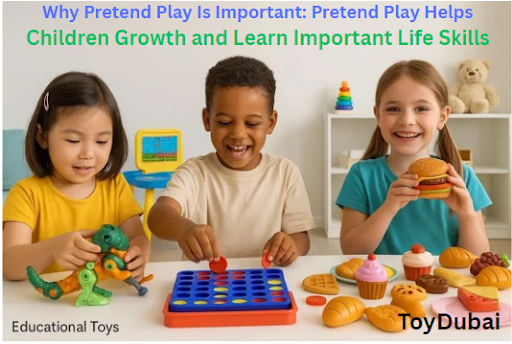

Pretend Play, often dismissed as mere make-believe, is actually a cornerstone of childhood development. It unlocks creativity, sharpens social skills, and builds emotional strength. Whether it’s a preschooler turning a cardboard box into a spaceship or acting as a doctor to a teddy bear, these moments aren’t just adorable — they are powerful developmental tools.
In this blog, we’ll explore in detail why you experiencepretend Activities is important, backed by research, real-life examples, and expert insight. We’ll also dive into the benefits of imaginative play for preschoolers, practical these type games examples, and tips for educators and parents. Let’s begin.
What Is Pretend Play? (And Why It’s More Than Just “Play”)
Pretend play, also called imaginative play or role play, involves children acting out scenarios from their imagination. It can be:
- Symbolic: Using objects to represent something else (e.g., a stick as a sword)
- Dramatic: Creating and acting out stories
- Role-Based: Playing “teacher,” “parent,” or “doctor”
Children begin showing signs of pretend play as early as 18 months, with complex role-play developing around age 3.
Difference Between Pretend Play and Other Types of Play
| Type of Play | Description | Age Group |
| Functional Play | Simple movements, e.g., stacking blocks | 0–2 years |
| Constructive Play | Building or creating | 2–4 years |
| Pretend/Dramatic Play | Using imagination and role play | 3–7 years |
| Games With Rules | Board games, sports | 6+ years |
child development isn’t about the toy—it’s about the transformation that happens in the child’s mind.
Why It’s Critical for Child Development
- Encourages symbolic thinking, which is essential for reading and math later on
- Stimulates language growth through dialogue and storytelling
- Builds social understanding by role-switching and empathy
Pretend play may look like simple fun on the surface, but it’s actually one of the most impactful learning experiences in early childhood. Activities like playing house, pretending to be a doctor, or reenacting a favorite story are far more than entertainment—they’re essential to a child’s growth. These playful moments serve as stepping stones to emotional intelligence, cognitive flexibility, and strong social skills.
When children engage in imaginative scenarios, they’re not only exploring creativity—they’re learning how to understand emotions, solve problems, build relationships, and adapt to new situations. These foundational skills are key for lifelong success, from navigating friendships to performing well in school and beyond.
In essence, child development is a child’s natural way of making sense of the world, and every imaginative moment shapes the way they think, feel, and connect with others. It’s fun, yes—but it’s also fundamental.
Cognitive Benefits of Pretend Play in Early Childhood
Pretend scenarios often involve obstacles. Whether a child is figuring out how to rescue a “trapped” teddy bear or managing a make-believe kitchen, they’re engaging in:
- Planning: Deciding roles, props, and storylines
- Reasoning: Solving social and imaginary problems
- Creativity: Thinking outside the box (literally!)
These exercises build executive functioning — the same skills needed for school readiness and adult success.
- Supports Memory and Sequencing: These actions mirror storytelling and narrative writing skills.
- Enhances Attention Span and Focus: Pretend play requires sustained attention, especially when children.
- Pretend Play and Academic Success
Fact: Children who frequently engage in imaginative play show 33% more complex vocabulary than their peers.
Emotional Development Through Imaginative Play
- Builds Emotional Intelligence
- Encourages Empathy and Perspective-Taking
- Reduces Anxiety and Stress
- Boosts Self-Esteem
Pretend play offers emotional outlets. A child afraid of a doctor’s visit might act as a doctor to gain control over that fear.
Social Benefits of Pretend Play for Preschoolers
Pretend play helps preschoolers build strong social skills by encouraging cooperation, sharing, and turn-taking. It also fosters empathy as children learn to see the world from different perspectives during role-play scenarios.
- Teaches Cooperation and Teamwork
- Develops Conflict Resolution Skills
- Promotes Inclusivity and Diversity
Pro Tip: Use multicultural dolls and diverse costumes to promote inclusive pretend play.
Language and Literacy Advantages of Pretend Play
- Vocabulary Expansion
- Narrative Skills Development
- Listening and Speaking Practice
- Early Literacy Concepts
Pretend play enriches language development by expanding vocabulary, enhancing storytelling abilities, and strengthening listening and speaking skills. It also introduces early literacy concepts, setting the stage for successful reading and communication later on.
Physical and Motor Skill Growth in child development
- Fine Motor Skills: Small movements are refined through
- Gross Motor Skills: Large-scale child development involves
- Hand-Eye Coordination: Children improve coordination through
- Spatial Awareness and Object Manipulation: Pretend activites environments help kids understand.
Pretend play strengthens both fine and gross motor skills by engaging children in activities that require precise movements and full-body actions. It also enhances hand-eye coordination and spatial awareness, helping kids interact more confidently with their environment.
Benefits of Role Play for Preschoolers
- Understanding Real-World Roles
- Preparing for School and Social Settings
- Exploring Aspirations and Passions
- Enhancing Moral Understanding
child development allows children to explore real-world roles, preparing them for school, social situations, and future aspirations. It also nurtures a sense of right and wrong, helping them develop moral understanding through imaginative experiences.
Final Thought:
Pretend play isn’t just fun—it’s a powerful tool that shapes a child’s social, emotional, and cognitive development. By encouraging imaginative activities, caregivers and educators lay the foundation for essential life skills that children will carry with them well beyond the preschool years. for more information Check in Here
FAQs
Pretend play boosts creativity, improves communication, strengthens social skills, and supports emotional development in children.
It helps develop language, problem-solving, empathy, cooperation, and critical thinking skills.
Babies begin to understand cause and effect, explore emotions, and develop early social and communication skills through simple pretend activities.
Role play allows children to explore real-life scenarios, build confidence, and learn how to interact with others in a safe and imaginative way.
